The Pomodoro Break Mistake That Quietly Cancels Out Your Eye Rest
Quick Answer: Taking regular Pomodoro-style breaks helps with mental fatigue, but if you spend those 5 minutes checking your phone, your eyes never actually get the near-focus break they need — the timer resets your brain, not your eye muscles.
You’ve got the timer app, the 25-on-5-off rhythm down, and you’re still ending the day with tired, strained eyes. The break itself isn’t the problem — what fills it usually is.

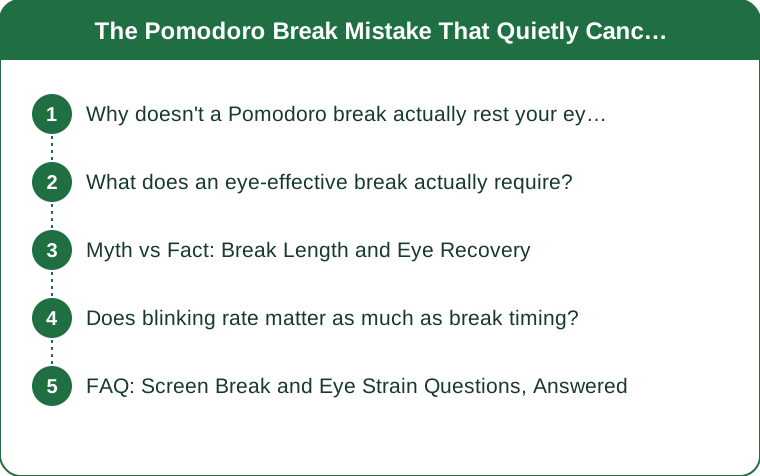
Why doesn’t a Pomodoro break actually rest your eyes if you’re still on a screen?
Eye strain from screens comes largely from sustained near-focus, not just screen brightness or blue light — your eye’s focusing muscles stay contracted for close-range vision the entire time you’re looking at something within a few feet. Switching from a laptop screen to a phone screen during a “break” keeps that near-focus muscle engaged the whole time, even though your brain gets the mental reset it needs from stepping away from work. The eyes never actually get the distance-focus reset that a real break is supposed to provide.
This is why some people finish a full day of disciplined Pomodoro breaks and still end up with the same eye fatigue as someone who worked straight through — the timer solved the mental fatigue problem while leaving the eye strain problem completely untouched.
What does an eye-effective break actually require?
Looking at something at least 20 feet away for a meaningful stretch of the break — not just a glance — is what actually resets the eye’s focusing muscles. A window view, a hallway, or just staring across a room works far better than a phone screen a foot from your face, even if the phone content itself feels relaxing. The distance matters more than what you’re looking at.
This is also why the classic 20-20-20 rule (every 20 minutes, look at something 20 feet away for 20 seconds) and a 5-minute Pomodoro break aren’t actually solving the same problem — the 20-20-20 rule is specifically an eye-muscle reset, while a Pomodoro break is a mental-fatigue reset. Doing one doesn’t automatically give you the other.

Myth vs Fact: Break Length and Eye Recovery
Myth: A longer break is always better for eye rest. Fact: A short break spent at true distance-focus does more for eye strain than a long break spent scrolling. Ten seconds looking out a window can do more for eye-muscle fatigue than five full minutes spent on a phone, because the muscle reset depends on focal distance, not time elapsed. Duration matters less than what your eyes are actually doing during that duration.
Does blinking rate matter as much as break timing?
Yes — screen use measurably reduces blink rate, sometimes by more than half compared to normal activity, and reduced blinking is a major contributor to the dry, gritty eye feeling people often blame entirely on blue light or brightness. A break spent actively blinking and, ideally, in a slightly more humid environment addresses a separate but equally real part of screen-related eye discomfort that distance-focus alone doesn’t fully solve.
FAQ: Screen Break and Eye Strain Questions, Answered
Does dimming my screen brightness reduce the need for real breaks?
It helps somewhat with overall visual comfort, but it doesn’t address the near-focus muscle fatigue that only distance-viewing actually resets — brightness and focus distance are separate variables.
Is a 5-minute Pomodoro break long enough for eye rest if I use it correctly?
Yes — even 30-60 seconds of genuine distance focus within that 5 minutes provides meaningfully more eye relief than the full 5 minutes spent on another screen.
Should I combine Pomodoro breaks with the 20-20-20 rule, or is one enough?
Combining them covers both problems at once — treat the 20-20-20 rule as a standing reminder inside your work blocks, and use the Pomodoro break itself for the longer mental and physical reset.
TL;DR:
- A Pomodoro break helps mental fatigue but not eye strain if you switch to another screen
- Genuine distance focus (20+ feet) during the break is what actually rests eye muscles
- Break length matters less than what your eyes are doing during it
- Reduced blink rate during screen use is a separate contributor worth addressing directly
The timer was never the missing piece — where your eyes actually land during those 5 minutes is.
Keep Reading
This article is for general informational purposes only and is not medical advice. Always consult a qualified health professional for guidance specific to you.