Why Your Screen Breaks Stop Working Once the Lights Come On Earlier
Quick Answer: Screen breaks work by relaxing the eye’s focusing muscle at distance and restoring blink rate. Both effects weaken under artificial light, because indoor sight lines are short and overhead lighting reduces contrast. In autumn you need longer breaks, genuinely distant targets, and deliberate blinking rather than the same 20 seconds that worked in summer.
You have taken the same breaks for two years and your eyes have started aching again by mid-afternoon.
Nothing about your work changed. Your screen did not change.
The light in the room changed, and screen breaks turn out to depend on it more than the rule suggests.
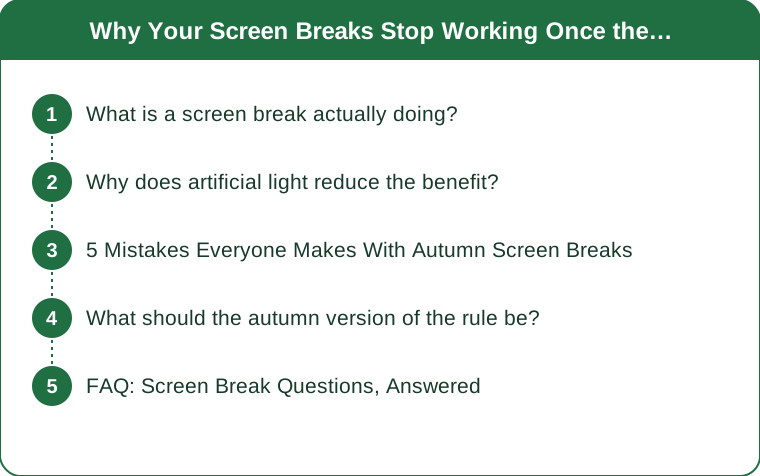
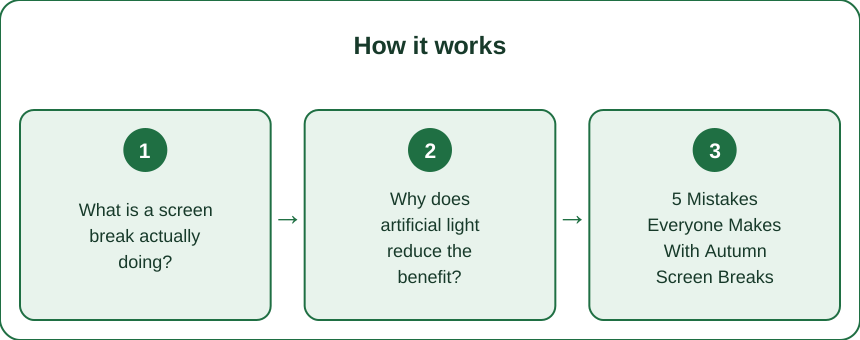
What is a screen break actually doing?
Two separate things, and they have different requirements.
The first is relaxing accommodation. The ciliary muscle contracts to focus on near objects and stays contracted for as long as you look at your screen. Looking at a distant object lets it release, and that release is the main relief a break provides.
The second is restoring blink rate. Blink frequency drops substantially during focused screen work — commonly by half or more — which leaves the tear film thin and the surface of the eye dry. Blinking properly for a few seconds restores it.
The standard advice bundles these together as 20-20-20: every 20 minutes, look at something 20 feet away for 20 seconds. It is a good rule and it quietly assumes two things — that there is something 20 feet away to look at, and that you can see it clearly enough to focus on it.
In a well-lit summer room with a window, both assumptions hold. In an artificially lit room in November, both weaken.
Why does artificial light reduce the benefit?
Because accommodation relaxes fully only when your eye has a clear distant target to lock onto, and low-contrast environments do not provide one.
Overhead artificial lighting is diffuse and flat. It produces less contrast between objects than daylight does, and the eye’s focusing system uses contrast as its cue. A distant wall under flat lighting gives your eye very little to actually focus on, so accommodation only partially releases.
There is also a pupil effect. In dimmer conditions the pupil dilates, which reduces depth of field and increases the focusing demand on any given target. The same distance is more work for the eye in a dim room than a bright one.
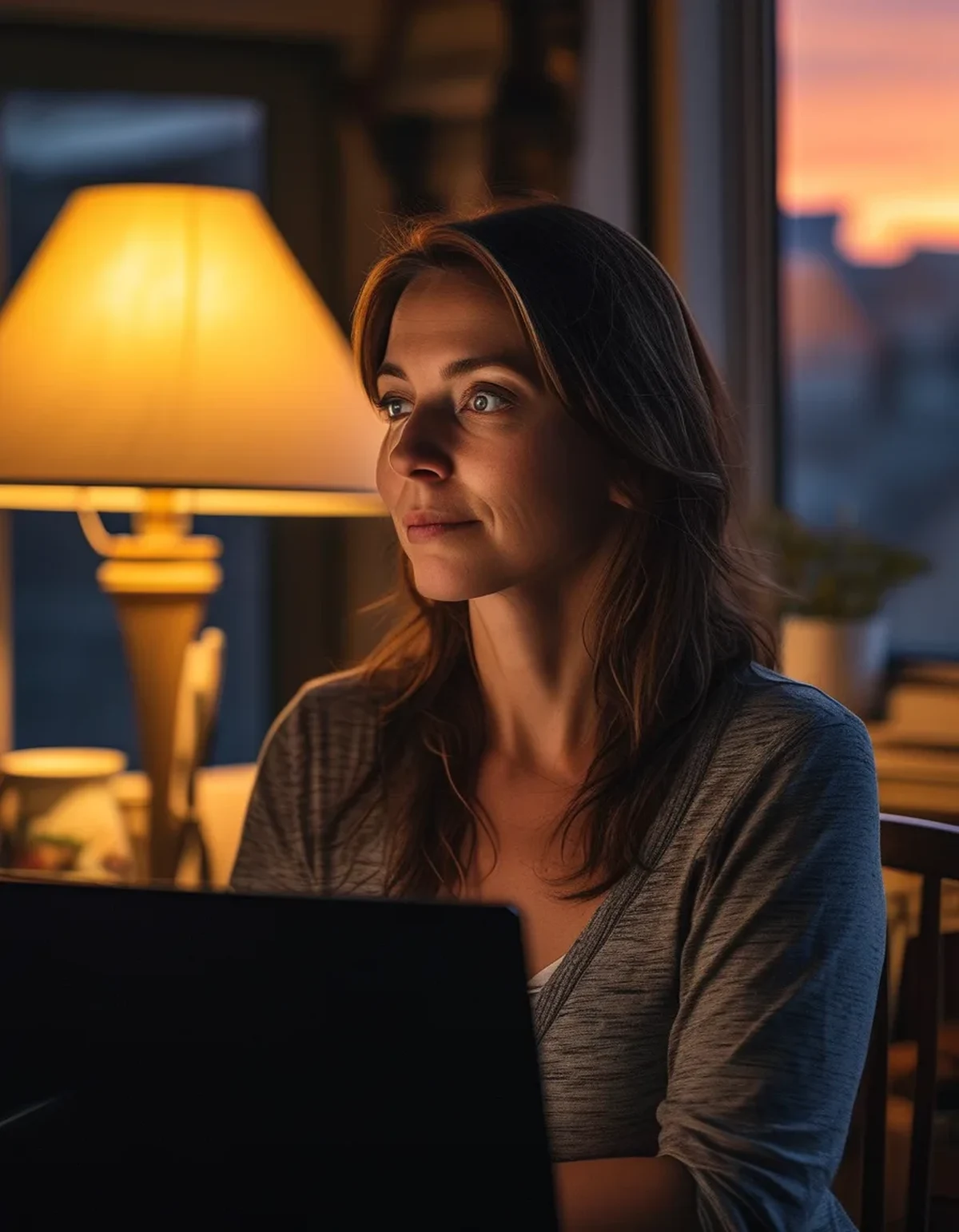
And the sight-line problem is simply geometric. In summer you looked out of a window, which offered targets at effectively infinite distance. In winter, at 4 p.m., the window is a dark reflective surface and your longest available sight line is the far wall — often under 20 feet, and sometimes under ten.
5 Mistakes Everyone Makes With Autumn Screen Breaks
1. Keeping the break at 20 seconds. Under low-contrast indoor light, full accommodative relaxation takes longer. Extend to 30 to 40 seconds through the darker months.
2. Looking at a blank wall. A featureless surface gives the eye nothing to focus on, which means accommodation does not fully release. Look at something with detail — a bookshelf, a picture, a doorway with defined edges.
3. Checking your phone as the break. A phone is a near target at a shorter distance than your monitor, which means it is the opposite of a break. This is the single most common way people take a break that is not one.
4. Not blinking deliberately. Looking away restores accommodation but does nothing automatic for blink rate. Add ten full, complete blinks — closing fully, not the partial flutter most people default to — during each break.
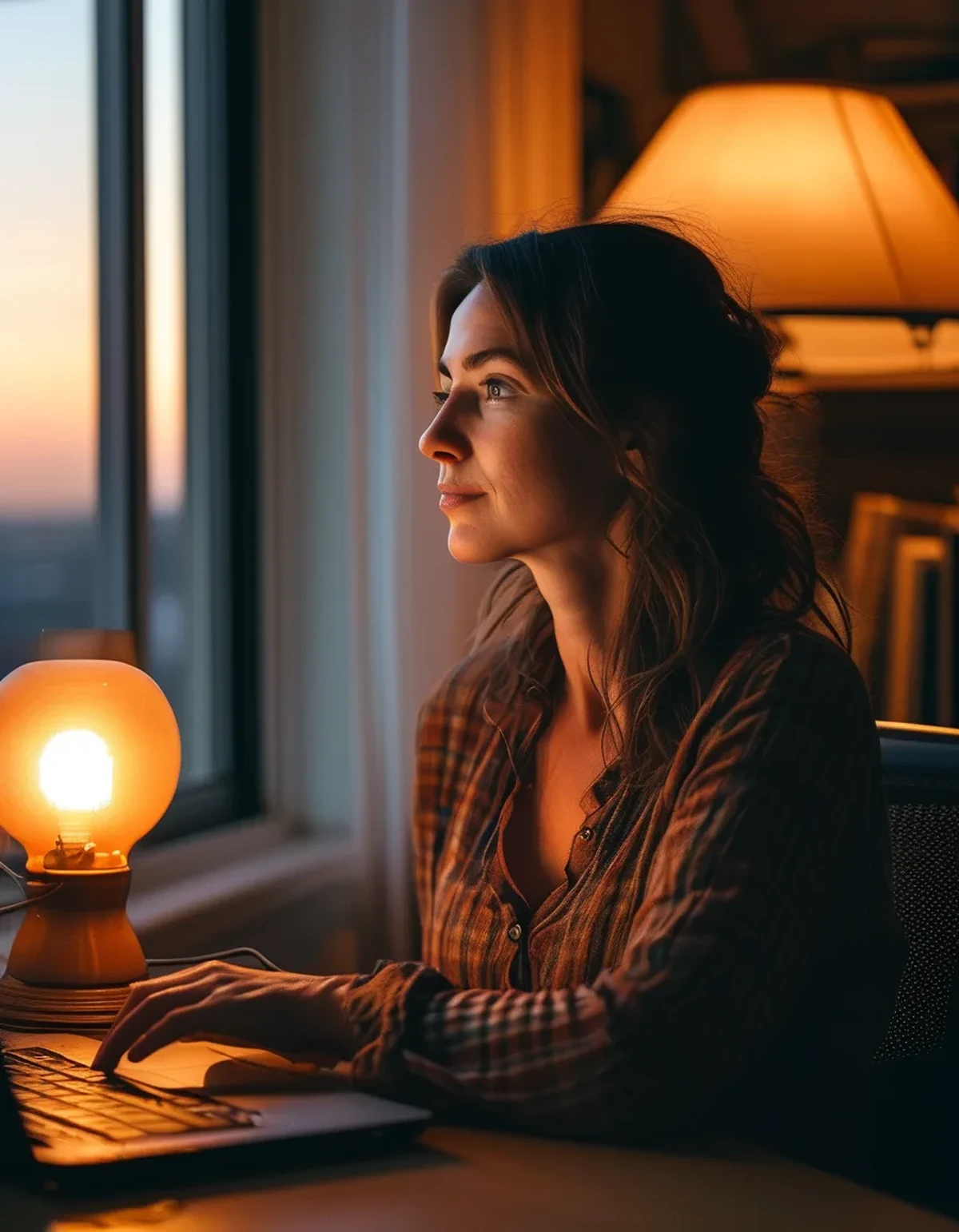
5. Leaving the overhead light as the only source. The fourth mistake compounds this one badly. A single diffuse overhead source flattens the room, and adding a lamp that creates shadow and contrast improves every break you take for the rest of the winter.
What should the autumn version of the rule be?
Every 20 minutes, find the most detailed object at the longest available distance, look at it for 30 to 40 seconds, and blink fully ten times while you do.
Then make three environmental changes that improve every break rather than any single one.
Add a second light source at a different height from your overhead — a desk lamp or a floor lamp. This creates contrast and shadow in the room, which gives your eye usable focusing targets and reduces pupil dilation.
Create a deliberate distance target. If your longest sight line is short, put something detailed at the far end of it — a poster with fine text, a shelf of books with visible spines. It sounds trivial and it materially improves the quality of every break.
And take one genuine outdoor break during daylight, even five minutes. Actual distance vision under natural light does more for accommodative fatigue than any number of indoor breaks, and in November the window for it is narrow enough that it needs to be scheduled rather than hoped for.
This is general information, not medical advice. Persistent eye pain, headaches, or vision changes warrant an eye examination rather than a better break routine.
FAQ: Screen Break Questions, Answered
Do blue light glasses help with this?
The evidence for blue light filtering reducing eye strain is weak. What helps is break quality, blink rate, screen brightness matched to the room, and adequate contrast in the environment.
Is a dark mode screen better in winter?
It can be, mainly because it reduces the brightness mismatch between the screen and a dim room. The more useful change is matching screen brightness to ambient light rather than choosing a theme.
How much does humidity matter?
More than most people think. Indoor heating drops relative humidity substantially, which thins the tear film independently of blink rate. A humidifier in a heated room addresses a real part of the autumn symptom picture.
TL;DR:
- Screen breaks work by relaxing focus at distance and restoring blink rate, and artificial light weakens both.
- Extend breaks to 30 to 40 seconds and choose a detailed distant target, never a blank wall.
- Add ten full deliberate blinks to each break — looking away does not do this on its own.
- Add a second light source for contrast, place a detailed object at your longest sight line, and schedule one daylight outdoor break.
The rule you have been following was written for a room with a window and daylight in it. Keep the rule and adjust the parameters for the room you are actually in, and the mid-afternoon ache that showed up in October should go with it.
Keep Reading
This article is for general informational purposes only and is not medical advice. Always consult a qualified health professional for guidance specific to you.