Why Your Eyes Feel Worse on the Days You Barely Looked at a Screen
Quick Answer: Screen use is one contributor to eye discomfort, not the only one. Dry indoor air, reduced blink rate during any focused task, seasonal allergies, poor sleep, low light and prolonged near work of any kind all produce the same symptoms. A day spent reading paper documents in a dry, air-conditioned room can be harder on your eyes than a day of screen work with good humidity and regular distance breaks. If low-screen days feel worse, look at the environment rather than the device.
You spent Saturday outdoors and away from screens and your eyes still ached by evening.
The screen was never carrying the whole explanation.

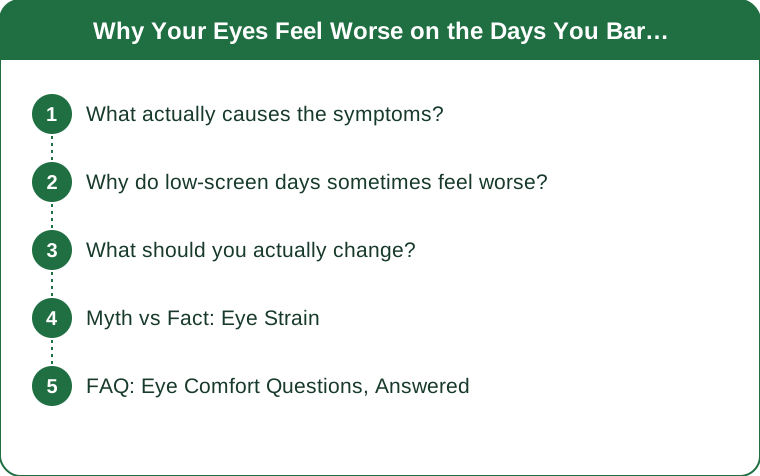
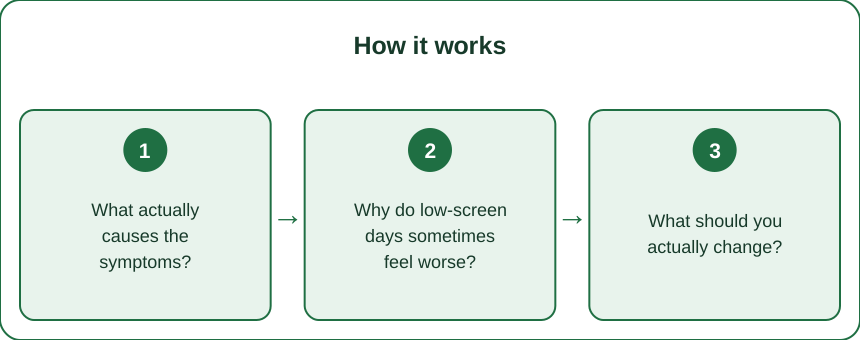
What actually causes the symptoms?
Reduced blink rate during focused visual tasks is one of the most commonly cited mechanisms, and it is not screen-specific - reading, sewing, driving and detailed handwork all reduce blinking.
Blinks also become incomplete during concentration, which spreads the tear film less effectively even when the blink count looks normal.
Dry air accelerates tear evaporation, which is why air conditioning, forced-air heating and low humidity all produce symptoms independently of what you were looking at.
Sustained near focus fatigues the focusing muscles, and paper at 30cm demands the same accommodation as a screen at 30cm.
Seasonal allergies produce itching, redness and watering that is easily attributed to screens, particularly in late summer and autumn.
And poor sleep reduces tear production and increases sensitivity to light, which is why a bad night shows up in your eyes before anywhere else.
Why do low-screen days sometimes feel worse?
Air conditioning and heating are the largest hidden variable. A day in a dry, air-conditioned car or building is harder on tear film than a day at a screen in a humid room.
Outdoor days bring wind, sun and pollen, all of which affect the eye surface directly.
You may have been doing intense near work without noticing - reading, cooking, detailed tasks, driving in bright conditions.
Sleep debt frequently accumulates on days off, especially after a late night, and shows up as eye discomfort.
Screen breaks are often better structured on work days, since work has natural interruptions - meetings, conversations, walking to another room - that a day of reading at home does not.
And symptoms lag exposure. Eye discomfort on Saturday can reflect Thursday and Friday, which makes single-day attribution unreliable.

What should you actually change?
Address humidity first. A humidifier in a dry room is one of the more reliable interventions and it is completely independent of screens.
Blink deliberately and completely - a slow full closure several times, a few times an hour. This targets the mechanism directly.
Look at something genuinely distant, out a window if possible, rather than closing your eyes. Distance viewing relaxes accommodation in a way closing your eyes does not.
Check the angle. Looking slightly downward at a screen or book exposes less eye surface than looking level or up, which reduces evaporation.
Move any air vent or fan so it is not blowing toward your face, which is a surprisingly common and easily fixed cause.
Treat allergies if they are seasonal, since antihistamine-responsive symptoms are a different problem from strain.
And get the sleep, which affects tear production directly. If symptoms persist, are painful, or come with vision changes, see an eye care professional. This is general information, not medical advice.
Myth vs Fact: Eye Strain
Myth: screens damage your eyes. Fact: the commonly reported symptoms are discomfort and fatigue rather than structural damage. Uncomfortable is real; harmful in a lasting sense is not well supported for ordinary screen use.
Myth: blue light is the main culprit. Fact: reduced and incomplete blinking, dry air and sustained near focus are far more consistently implicated. Blue light filtering has not shown strong effects on strain symptoms in reviews.
Myth: the 20-20-20 rule solves it. Fact: it addresses accommodation by giving the focusing system a distance break, which is genuinely useful. It does not address blink rate, humidity, posture or neck position - so it helps partially and people conclude nothing works.
Myth: if you had no screen time, it cannot be eye strain. Fact: any sustained near task reduces blinking and demands accommodation. Paper, sewing and detailed handwork all produce the same symptoms.
Myth: closing your eyes is the best break. Fact: it helps with dryness but does nothing for accommodation. Looking at something far away addresses the focusing side, which closing your eyes cannot.
Myth: brighter rooms cause more strain. Fact: a room that is too dim relative to the screen is a more common problem, because the contrast difference makes the eyes work harder. Matching ambient light to screen brightness generally helps.
FAQ: Eye Comfort Questions, Answered
Why do my eyes hurt on days without screens?
Dry air, reduced blinking during any focused task, allergies, poor sleep and sustained near work all produce the same symptoms independently of screens.
Does blue light cause eye strain?
Current reviews do not strongly support it as a main driver. Blink rate, air dryness and sustained near focus have far more consistent support.
What is the single most effective change?
For many people, addressing air dryness - a humidifier, and moving vents or fans away from the face. It is unrelated to screens and frequently overlooked.
Is closing my eyes a good break?
It helps dryness but not focusing fatigue. Looking at something genuinely distant addresses the part closing your eyes cannot.
Why are my eyes worse in autumn?
Heating systems dry indoor air, daylight hours shorten so more time is spent in artificial light, and seasonal allergens are still present in many regions.
When should I see a professional?
If symptoms are painful, persistent despite changes, accompanied by vision changes, or if there is discharge or significant redness. This is general information, not medical advice.
TL;DR:
- Reduced and incomplete blinking during any focused task - not just screens - is a primary mechanism.
- Dry air from air conditioning and heating is the most commonly missed cause.
- Sustained near focus on paper demands the same accommodation as a screen at the same distance.
- Allergies and poor sleep produce nearly identical symptoms.
- Look at something genuinely distant rather than closing your eyes.
- Move fans and vents away from your face, and match ambient light to screen brightness.
If low-screen days feel worse, the environment is the variable. This is general information, not medical advice.
Keep Reading
This article is for general informational purposes only and is not medical advice. Always consult a qualified health professional for guidance specific to you.