The 20-20-20 Rule Helps Your Eyes But Not Your Neck — Here's What Does
Quick Answer: The 20-20-20 rule (every 20 minutes, look 20 feet away for 20 seconds) helps eye strain but does nothing for neck and shoulder tension from screen posture — pairing it with a posture reset every hour covers both problems.
You’ve followed the 20-20-20 rule religiously, your eyes feel fine, and your neck still aches by 3pm. The rule was never designed to fix that part.

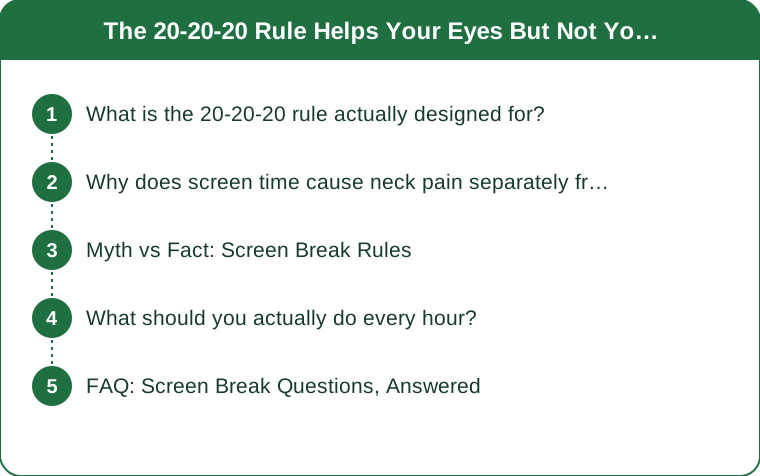
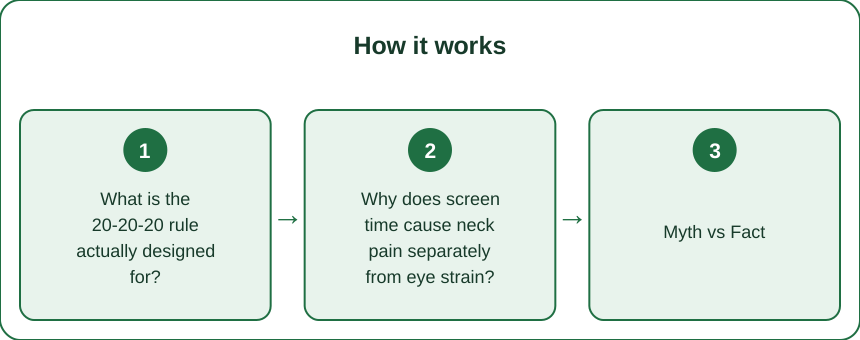
What is the 20-20-20 rule actually designed for?
It targets eye strain from sustained close-focus work — every 20 minutes, looking at something 20 feet away for 20 seconds lets your eye muscles relax from constant near-focus. It’s genuinely effective for that specific problem, backed by consistent recommendations from eye care professionals.
What it doesn’t address at all is the static posture your neck and shoulders hold during those same 20-minute stretches — that’s a separate mechanism entirely.
Why does screen time cause neck pain separately from eye strain?
Looking down or forward at a screen for extended periods puts your head in a forward position that multiplies the effective weight your neck muscles support — every inch your head moves forward adds significant load. This is a muscular fatigue problem, unrelated to how your eyes are focusing.
That’s why you can do the 20-20-20 rule perfectly and still end the day with neck and upper back tension — you fixed one system and left the other running.

Myth vs Fact: Screen Break Rules
Myth: If your eyes feel fine, your screen setup is fine. Fact: eye comfort and postural strain are separate systems — you can have one without the other being fixed.
Myth: Standing up occasionally is enough to fix screen fatigue. Fact: standing without correcting your head and neck position (like hunching over a laptop while standing) doesn’t resolve the forward-head loading that causes the ache.
What should you actually do every hour?
Add a posture reset: stand, roll your shoulders back and down, tuck your chin gently (like making a slight double chin) to realign your head over your spine, and hold for a few breaths. Combine this with the 20-20-20 rule so you’re addressing eyes every 20 minutes and posture every 60 minutes.
Raising your screen to eye level and keeping your elbows supported also reduces how often you need the reset in the first place — prevention plus breaks work better than breaks alone.
FAQ: Screen Break Questions, Answered
Does blue light cause more strain than posture?
Blue light’s role in eye strain is debated and likely minor compared to focus distance and blink rate; posture-related neck pain is a distinct and often larger issue for desk workers.
How often should I do a posture reset?
Once an hour is a reasonable target for most desk workers, more often if you already have neck or shoulder tension.
Can screen height alone fix tech neck?
It helps significantly by reducing forward head tilt, but combining it with periodic posture resets addresses both the setup and the habit.
TL;DR:
- 20-20-20 rule fixes eye strain, not neck and shoulder tension
- Forward head posture adds real physical load to neck muscles
- Add an hourly posture reset alongside the 20-20-20 rule
- Raising screen height reduces how often you need to reset
Run both habits together for a week and notice which ache actually disappears — it tells you which system needed the fix.
Keep Reading
This article is for general informational purposes only and is not medical advice. Always consult a qualified health professional for guidance specific to you.