Why Looking Out a Window Beats Closing Your Eyes on a Screen Break
Quick Answer: The main source of screen-related eye fatigue is the ciliary muscle held in sustained near-focus contraction. Closing your eyes rests the eyelids and reduces light input, but the ciliary muscle stays partially engaged at a resting focal point around arm’s length. Looking at something 20 or more feet away actively relaxes it. That’s why a 20-second window break outperforms a 2-minute eyes-closed break.
Every instinct says the dark, quiet option must be the restorative one. But the tired part of your eye isn’t the part that light bothers — and once you know which muscle you’re actually trying to release, the whole break calculus changes.

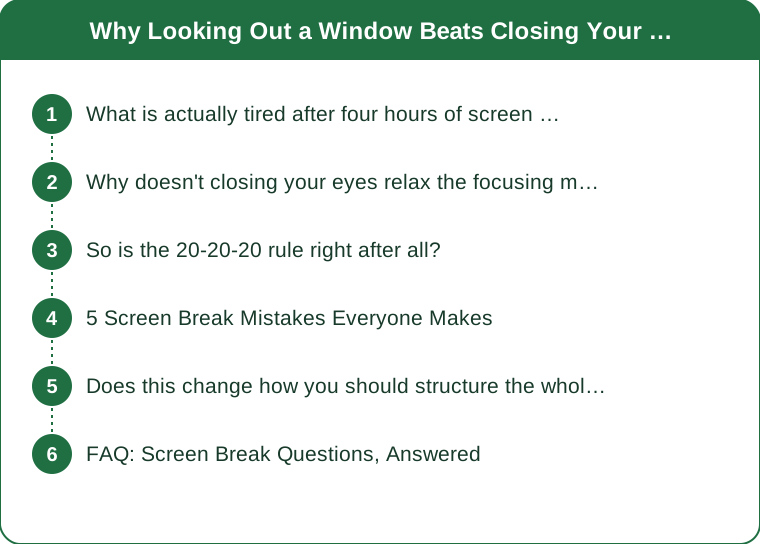
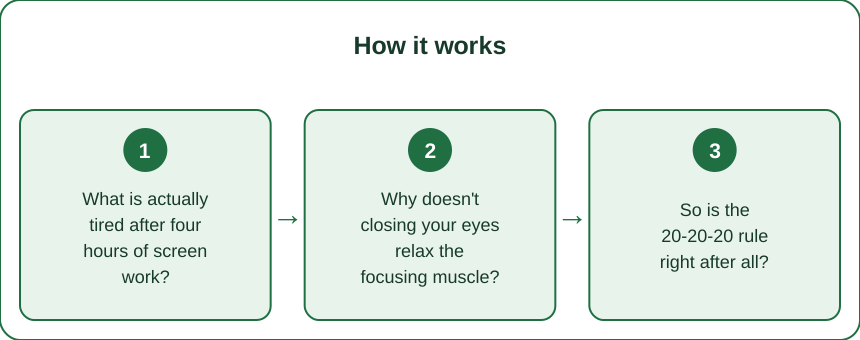
What is actually tired after four hours of screen work?
Two different systems, and they want opposite things.
The first is your ciliary muscle, a ring of muscle inside the eye that changes the lens shape to focus close up. Reading a screen at 20 to 24 inches keeps it contracted, more or less continuously, for as long as you look.
The second is your tear film, which thins out because blink rate drops from roughly 15 to 20 blinks per minute down to 5 to 7 when you’re concentrating on a display.
Closing your eyes helps the second problem beautifully. It barely touches the first. And for most people, the ache-behind-the-eyes feeling is the first one.
Why doesn’t closing your eyes relax the focusing muscle?
When your eyes are closed, focus doesn’t go to infinity. It drifts to what’s called the dark focus or resting point of accommodation — typically somewhere between 20 inches and 5 feet, depending on the person.
That’s better than 22 inches, but it’s still a partially contracted state. You’ve dropped the load, not removed it.
Distance viewing is different. When you focus on something 20 feet or further, the ciliary muscle goes to genuine minimum tension. The lens flattens, the muscle releases, and the actual fatigued tissue gets a real break.
The practical upshot is unintuitive: 20 seconds of looking out a window does more for focusing fatigue than two minutes with your eyes shut.
So is the 20-20-20 rule right after all?
The structure is right, the framing is often wrong. Every 20 minutes, look at something 20 feet away for 20 seconds — the distance is the active ingredient, not the timer.
Where people undercut it: looking across a small room. If the far wall is 9 feet away, you’ve reduced the demand by roughly half but you haven’t eliminated it. A window with sky, a street, or a tree line is what you want.
No window? A hallway works. So does the far end of an open floor. What doesn’t work is your phone, which is closer than your monitor and makes the problem worse.
And 20 seconds is a floor, not a target. 30 to 60 seconds of distance viewing is meaningfully better, and still costs you almost nothing.

5 Screen Break Mistakes Everyone Makes
1. Breaking with your phone. You’ve swapped a 22-inch focal distance for a 14-inch one. This is a worse break than no break.
2. Breaking by duration instead of distance. A ten-minute break spent reading a printed page is ten minutes of continued near focus.
3. Waiting until it hurts. By the time you feel the ache, the muscle has been in sustained contraction for an hour or more, and it takes proportionally longer to settle.
4. Forgetting to blink deliberately. Distance viewing fixes focus fatigue but not dryness. Ten slow, full blinks during the break covers both.
5. Treating eyes-closed as the gold standard. It’s excellent for tear film and light sensitivity, genuinely poor for accommodation. Use it as a supplement, not a substitute.
Does this change how you should structure the whole day?
It shifts the emphasis from long breaks to frequent distance exposure.
A useful pattern: brief distance glances every 20 to 30 minutes, a proper 5-minute standing break every 90 minutes, and at least one genuinely outdoor stretch during daylight. Outdoor light also matters for reasons beyond eye comfort — daytime bright-light exposure supports circadian timing, which is its own conversation.
If you can, move your monitor so a window sits in your peripheral field. People with a distance sightline take distance breaks without deciding to, which beats any reminder app.
And if strain persists through weekends and holidays, that’s not a break-schedule problem. Uncorrected astigmatism, an outdated prescription, or dry eye disease all present this way. This is general information, not medical advice — persistent eye pain, vision changes, or headaches deserve an eye exam.
FAQ: Screen Break Questions, Answered
Is 20 seconds really enough?
It’s the minimum that produces measurable relaxation of accommodation. Thirty to sixty seconds is better, and if you’re deep into a long stretch of close work, a full minute is a reasonable habit.
What if I have no window and no long sightline?
Stand at the longest available line of sight — a corridor, a stairwell, an open doorway — and focus on the furthest visible detail. It’s a compromise, but it’s still substantially better than a wall two feet away or a phone.
Do blue light glasses replace breaks?
No. The evidence for blue-blocking lenses reducing digital eye strain is weak, and they don’t address accommodation at all, which is the mechanism doing most of the damage here. Distance viewing and blinking are free and better supported.
TL;DR:
- The tired structure is the ciliary focusing muscle, and only distance viewing truly releases it.
- Eyes-closed rests the tear film and light sensitivity, not focus — it’s a supplement, not a substitute.
- Distance is the active ingredient in 20-20-20; a small room doesn’t count.
- Breaking with your phone is worse than not breaking at all.
The best screen break costs 30 seconds and requires nothing but turning your head toward the furthest thing you can see. It feels too small to matter, which is exactly why almost nobody does it consistently — and why the people who do notice the difference by the end of the first week.
Keep Reading
This article is for general informational purposes only and is not medical advice. Always consult a qualified health professional for guidance specific to you.