Why the 20-20-20 Rule Fails in Practice and What Actually Sticks
Quick Answer: The 20-20-20 rule — every 20 minutes, look 20 feet away for 20 seconds — fails not because the ophthalmology is wrong but because the behavior design is: it demands 24 interruptions a day, each arriving mid-thought, enforced by nothing but memory. Deep focus makes you blind to timers, and a rule that fights your best work loses every negotiation. What sticks is different architecture — breaks anchored to natural task seams, an environment that forces distance gazing without deciding to, deliberate blinking, and a few longer resets that do more than two dozen skipped micro-breaks ever would.
Here is why the rule loses to your workday, and the system that does not.

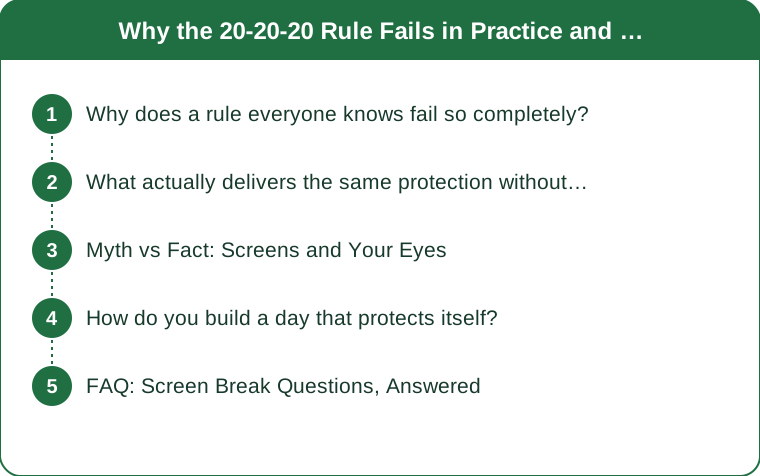
Why does a rule everyone knows fail so completely?
Because it was designed for eyeballs, not for humans with jobs.
The optics are sound: screen work parks your focusing muscle in a sustained near-contraction, and your blink rate silently drops by roughly half in front of a display — often with more incomplete blinks that never re-oil the eye’s surface. Distance gazing releases the focus muscle; blinking restores the tear film. Nothing about the underlying problem is controversial.
The failure is the delivery mechanism. Twenty-four scheduled interruptions per workday is a behavioral demand that almost no one can pay. Each one lands as a cost precisely when you are most engaged — and deep engagement is exactly the state in which humans stop perceiving timers, notifications, and mild discomfort. The rule asks you to interrupt focus, using a signal that focus makes you deaf to.
Worse, the rule picks fights with your best hours. Flow — the immersed state your hardest work happens in — takes several minutes to enter and one glance at a popup to exit. A literal 20-minute interruption cycle taxes precisely the sessions that matter most, so your brain learns to dismiss the reminder as an enemy of the work. Within a week, the timer is white noise; within two, it is uninstalled.
And because eye strain builds silently — no sharp signal until the headache or the gritty six-o-clock haze — there is no feedback loop rewarding compliance. You skip a break, nothing happens; you take one, nothing obvious happens either. Habits do not survive on invisible rewards and 24 daily willpower checks.
So the fix is not recommitting harder to a broken interface. It is redesigning where the breaks come from — moving them off willpower entirely.
What actually delivers the same protection without the fight?
Four mechanisms that run on structure instead of memory.
Anchor breaks to seams, not clocks. Your day is already full of natural pause points: sent the email, finished the section, ended the call, hit compile, poured the coffee. Attaching a 20-second distance gaze to seams costs zero focus — the thought was already complete. The practical version: pick three seam events you hit constantly and make each one a trigger — after every meeting ends, I look out the window while the tab closes. Habits chained to existing events survive; habits chained to timers do not.
Make the environment do the remembering. Position your desk so a window or the longest sightline in the room sits beside or behind your screen — every stray thought and phone glance now includes free distance gazing. Water on the desk earns double: hydration, plus a bathroom-and-refill walk that is a genuine break you cannot skip. The best break systems are the ones that happen to you.
Blink on purpose at trigger moments. Since screens halve your blink rate silently, attach five slow, complete blinks — full closure, a beat, open — to something you do constantly: every save, every page load, every time you unlock your phone. This one is invisible, free, and directly targets the dry-eye half of screen strain that distance gazing does not touch.
Trade micro-breaks you skip for macro-breaks you keep. Two or three genuine 5-minute resets — walk to the mailbox, stretch, stand at the window — deliver more recovery than twenty-four theoretical 20-second pauses at 10% compliance. A lunchtime walk outdoors is the heavyweight: sustained distance focus, full-spectrum light, and an actual attention reset in one habit you already half-do. This late-summer stretch, with long evenings and mild mornings, is the easiest season of the year to install it.
The honest accounting: perfect 20-20-20 compliance would beat this system slightly. But this system at 90% adherence demolishes 20-20-20 at 10% — and 10% is what the rule actually gets.

Myth vs Fact: Screens and Your Eyes
Myth: screens permanently damage your eyes. Fact: the strain — tired focus muscles, dry surface, headaches — is real, unpleasant, and temporary; current evidence does not show screens causing lasting damage to adult eyes. This matters because it reframes the goal from fear to comfort: you are managing fatigue, not preventing blindness — which is also why solutions can be relaxed instead of anxious.
Myth: blue light filters solve eye strain. Fact: research keeps failing to find meaningful eye-strain relief from blue-blocking lenses and filters — strain comes from focusing effort and reduced blinking, neither of which cares about color. Evening blue light does matter for sleep timing; for daytime comfort, the free settings — bigger text, brightness matched to the room, glare killed — outperform the specialty glasses.
Myth: exactly 20 feet and exactly 20 seconds matter. Fact: the numbers are a memorable prescription, not physiology thresholds. What your focusing system needs is genuinely far and genuinely relaxed for long enough to release — the end of the hallway, the trees across the street, out any window. Anything past roughly 20 feet is optically close to infinity for this purpose; a soft 15-second gaze that happens beats a precise 20 that does not.
Myth: dark mode protects your eyes. Fact: preference, mostly. Dark backgrounds reduce glare in dim rooms but can slightly increase focusing effort for text; comfort research is a wash. Use what feels good — and spend the energy on room lighting instead: no window glaring behind the monitor, no lamp reflecting off it, screen brightness in the neighborhood of the wall behind it.
Myth: if my eyes feel fine, I am fine. Fact: the strain signal is famously laggy — the cost of a hard screen morning bills in the late afternoon as haze, headache, or gritty dryness. Which is exactly why systems beat sensations: by the time your eyes complain, the preventable window was hours ago.
How do you build a day that protects itself?
A template — steal it, then adjust doses to your job.
Setup, once: monitor an arm’s length away, top of the screen near eye height, text sized so you never crane. Desk turned so a window or long sightline is in view without effort. Brightness matched to the room, glare sources killed. This half-hour of arrangement quietly outperforms months of remembering.
Morning block: work in your natural focus sessions — most people run 45 to 90 minutes before a seam appears on its own. At each seam: stand, 20 seconds on the longest view available, water. That is the whole ritual; it rides on the seam, not on a timer.
Midday: the outdoor walk, even ten minutes. Distance focus, daylight, movement — the single highest-value entry in the entire system, and the one that also resets attention for the afternoon.
Afternoon: this is when compliance historically dies and dryness peaks, so shift tactics — lean on the blink triggers, take calls standing or walking when the call allows, and if remote, relocate for one block: the sofa, the kitchen counter, anywhere that changes viewing distance and posture in one move.
Evening: if the day ran long on screens, end with 30 seconds of genuinely far gazing out the darkest available window and a conscious brightness drop on whatever screen follows. Evening comfort is mostly about not stacking a bright close screen on eyes already spent.
One escalation rule: persistent headaches, eyes that burn every day, double vision, or vision that blurs beyond a momentary refocus are not screen-habit problems — they are get-checked problems. An eye exam that mentions your actual screen distances lets the optometrist tune for it, and uncorrected small prescriptions masquerade as screen strain constantly. This is general information, not medical advice.
Run the template two weeks. The measure of success is boring and specific: the 6pm haze, the afternoon headache, the gritty blink — quieter or gone.
FAQ: Screen Break Questions, Answered
Is looking at my phone a screen break?
No — same near distance, same reduced blinking, often held closer than the monitor. A phone check is a task switch, not an eye break. The test of a real break is focal distance: if it is within arm’s reach, it is more screen.
Do the eye-exercise apps and eye yoga routines help?
The useful core is the same two ingredients — distance refocusing and deliberate blinking — wrapped in ceremony. Nothing wrong with an app that gets you to do them; nothing magic beyond them either. Rolling your eyes in circles has no evidence behind it and is fine as a stretch that feels nice.
I wear contacts and my eyes are wrecked by 5pm. Same advice?
Same plus one: contacts amplify the dry-eye half of the equation, so the blink work matters double and rewetting drops are a legitimate tool. If dryness is daily, the fix conversation belongs with your eye doctor — lens material and wear schedule change this picture more than any break rule.
Are screens worse for kids’ eyes?
Different question with a different answer: near-work hours in childhood are linked to myopia progression, and outdoor daylight time appears protective. For kids, the intervention with real evidence is more outside time — which, conveniently, is the same prescription the midday walk gives adults.
TL;DR:
- The optics behind 20-20-20 are sound; the behavior design is not — 24 timer-driven interruptions a day lose to deep focus every time.
- Anchor distance gazes to natural task seams, and arrange the desk so a long sightline happens to you without deciding.
- Blink deliberately at trigger moments — screens halve your blink rate silently — and trade skipped micro-breaks for two or three real resets plus a midday outdoor walk.
- Blue-light glasses and dark mode are sideshows; room lighting, screen position, and text size are the main event. Persistent symptoms mean an eye exam, not a better timer.
Tonight, turn your desk five degrees toward the window and pick your three seam triggers. The system starts working tomorrow without asking you to remember anything at 3pm.
Keep Reading
This article is for general informational purposes only and is not medical advice. Always consult a qualified health professional for guidance specific to you.