Why Your Break Timing Should Follow Your Task, Not a Fixed Clock
Quick Answer: Fixed-interval reminders fire regardless of what you’re doing, which means they land mid-thought as often as not — and a reminder dismissed mid-thought trains you to dismiss all of them. Task-boundary breaks, taken at natural completion points with a ceiling of about 50 minutes, get taken far more reliably because they don’t cost anything to accept.
You installed the app. You set it to 20 minutes. For four days you took the breaks, and now you dismiss the notification without reading it. That isn’t a discipline problem — it’s what happens when a system interrupts you at random relative to your actual work.

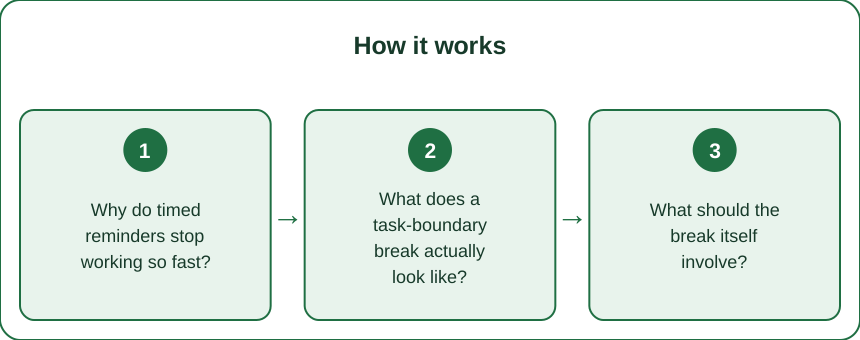
Why do timed reminders stop working so fast?
Because a fixed interval has no information about your task, so roughly half of its alerts arrive at the worst possible moment.
When a reminder fires while you’re mid-sentence, mid-calculation, or mid-debug, taking the break costs real work — you lose the state you were holding. So you dismiss it. Reasonably.
But dismissal is a learned response, and it generalizes. After a week, you’re dismissing the well-timed alerts along with the badly-timed ones, because the action has become automatic. The system trained you out of using it.
Research on task interruption consistently finds that interruptions at subtask boundaries are far less costly than interruptions mid-subtask — both in resumption time and in the frustration people report. A fixed timer is boundary-blind by design.
Why 20-20-20 has the same problem
The eye-strain guidance — every 20 minutes, look 20 feet away for 20 seconds — is sound in its physiology and poor in its implementation, for exactly this reason. The interval is arbitrary relative to your work, so compliance collapses. The advice isn’t wrong; the trigger mechanism is.
What does a task-boundary break actually look like?
You take the break when a natural unit of work ends, with a maximum interval as a backstop.
The natural boundaries are obvious once you look for them: sending an email, finishing a section, completing a function, saving a draft, ending a call. Every kind of work has them, usually every 10-40 minutes.
The ceiling prevents the obvious failure mode. Set a soft alert at 50 minutes — not as a command, but as a prompt to take the next boundary rather than the one after it. Without a ceiling, a long absorbing task runs three hours and you’ve lost the whole point.
The floor matters too. If boundaries are coming every four minutes, you’re doing shallow work and don’t need a break at each one. Take them every third or fourth.
Why this actually gets used
A break at a boundary costs almost nothing — the work state is already saved, mentally and often literally. When the cost is near zero, compliance stays high indefinitely, which is the entire difference between a system you use for two weeks and one you use for two years.

What should the break itself involve?
Different from what most break advice suggests, because eye rest and postural rest need different things.
For your eyes: distance, not darkness. Looking at something 20+ feet away lets the ciliary muscle relax from its sustained near-focus contraction. Closing your eyes does less for this than people assume. A window is the ideal target; a long hallway works.
For your posture: change position, not just stand. Standing up while keeping the same rounded upper back doesn’t do much. The useful move is extension — the opposite of your working posture. Reaching overhead, opening the chest, looking up.
For your attention: don’t switch to another screen. A phone break is a screen break in the sense that it’s a different screen, and neither the eyes nor the neck get anything out of it. This is the most common way a well-intentioned break provides zero benefit.
Duration: 60-120 seconds is enough for the eye and postural components. Longer breaks are good for other reasons but aren’t required for this.
The one-sentence version
Stand up, walk to a window, look at something far away, and reach your arms overhead for a minute. That’s the whole protocol, and it covers eyes, neck, and circulation simultaneously.
5 Mistakes People Make With Screen Breaks
1. Setting the interval too short. Twenty minutes is more frequent than most deep work allows. A 40-50 minute ceiling with boundary triggers is far more sustainable and delivers most of the benefit.
2. Taking the break on a phone. Same near-focus demand, worse neck angle. This is the single most common way breaks fail to help.
3. Standing without changing posture. A standing desk with the same forward head position produces the same neck loading. Position change is the mechanism, not verticality.
4. Treating the break as optional when busy. The days when you don’t feel you can spare 90 seconds are precisely the days of longest unbroken screen exposure. The correlation runs the wrong way from how people act on it.
5. Ignoring the actual environment. Screen brightness relative to the room, distance to the monitor, and air dryness all affect eye comfort more than break frequency does. Autumn heating season is a genuine factor here — indoor humidity drops sharply, which reduces tear film stability and makes the same screen time noticeably more uncomfortable than it was in August.
FAQ: Break Timing Questions, Answered
Does the Pomodoro technique work at all then?
It works well for tasks with poor intrinsic structure — administrative work, studying, anything where you struggle to start. It works poorly for deep work with natural boundaries, which is where most people try to apply it.
How do I remember to take boundary breaks without a timer?
Use the ceiling alert as the only notification, and let boundaries do the rest. Most people find that after two weeks the boundary trigger becomes automatic.
Are blue light glasses worth it?
The evidence for blue light causing eye strain is weak. Reduced blinking during screen use is much better supported as the primary mechanism — which breaks address directly and glasses don’t.
What if my work has no natural boundaries?
Create them. Deciding in advance what counts as one unit — a section, a batch of ten items — gives you boundaries and improves focus independently.
Should I look at something far away or close my eyes?
Distance. The muscle that needs to relax is the one controlling focus, and it releases when you focus far away. Closed eyes rest the surface but not the focusing mechanism.
TL;DR:
- Fixed-interval reminders are boundary-blind, so half arrive mid-thought and train you to dismiss them
- Take breaks at natural task boundaries, with a 50-minute ceiling as a backstop
- Look 20+ feet away, change posture into extension, and stay off the phone
- 60-120 seconds is enough for the eye and postural benefits
- Heating season lowers indoor humidity, making the same screen time harder on your eyes
The reason your break app stopped working isn’t that you lack discipline. It’s that it interrupted you at random and you correctly learned to ignore it. Trigger on boundaries instead and the compliance problem disappears.
Keep Reading
This article is for general informational purposes only and is not medical advice. Always consult a qualified health professional for guidance specific to you.